Sometimes despite the nice, warm sunny day we can still make out storm clouds gathering and the sense of gratefulness and pleasantry is immediately tinged with a little bit of trepidation and anxiety. Such is the wheel of life that you are both at the top and the bottom at the same time! The ability to balance both, separate out the strands and finally emerge knowing clearly where you stand is important.
At the moment, the trepidation lies with the people of power and authority surrounding me - the bigoted mind of you are not worthy as compared to my Pikachu who comes from this esteemed bank and billionaire family heritage, the short-sighted politician with the fixed view on everything that is rectified the next time someone points out that how wrong it is, the dogmatic intellectual who is always correct (and always wrong too) because he argues both ends of the spectrum at the same time, the manipulative leader - who unable to articulate his thoughts and is too insecure and views his time as too precious to take people through his own thought process but argues his position piecemeal until after a long, exhausting process ends up as the completed 400-peice jigsaw he intended in the first place, the seemingly secure, sophisticated urbanite who will not admit to his upbringing and is too jaded to stand up to his position, the clever technocrat who is intent to keep his hands clean of all unnecessary burden from the lower-caste society he is brought on to heal and bring to civilised world.
So, where does that leave me?
I suppose how I carry myself changes. Being facetious when senior is more fun. I think not being taken seriously does put me on edge.
Better fashion sense, better seriousness and bringing issues and agenda that pushes the envelope. Showing better conviction. Making sure I have the right charisma to convince.
The habits of the wealthiest mirror the supposed ‘pathologies’ of the
poor. But while those in poverty are called lazy, the rich are dubbed
bon vivants
We don’t hear much about laziness, drug addiction or promiscuity among
the wealthiest members of society because most billionaires go to great
lengths to seek privacy.
Illustration: Sonny Ross
If nearly a decade interviewing the wealth managers
for the 1% taught me anything, it is that the ultra-rich and the
ultra-poor have a lot more in common than stereotypes might lead you to
believe.
In conversation, wealth managers kept coming back to the flamboyant
vices of their clients. It was quite unexpected, in the course of
discussing tax avoidance, to hear professional service providers say
things like:
“I’ve told my colleagues: ‘If I ever become like some of our clients,
shoot me.’ Because they are really immoral people – too much time on
their hands, and all the money means they have no limits. I was actually
told by one client not to bring my wife on a trip to Monaco unless I
wanted to see her get hit on by 10 guys. The local sport, he said, was
picking up other men’s wives.”
The clients of this Geneva-based wealth manager also “believe that
they are descended from the pharaohs, and that they were destined to
inherit the earth”.
If a poor person voiced such beliefs, he or she might well be
institutionalized; for those who work with the wealthy, however, such
“eccentricities” are all in a day’s work. Indeed, an underappreciated
irony of accelerating economic inequality has been the way it has
exposed behaviors among the ultra-rich that mirror the supposed
“pathologies” of the ultra-poor.
In fact, one of the London-based wealth managers I interviewed said
that a willingness to accept with equanimity behavior that would be
considered outrageous in others was an informal job requirement.
Clients, he said, specifically chose wealth managers not just on
technical competence, but on their ability to remain unscandalized by
the private lives of the ultra-rich: “They [the clients] have to pick
someone they want to know everything about them: about Mother’s lesbian
affairs, Brother’s drug addiction, the spurned lovers bursting into the
room.” Many of these clients are not employed and live off family
largesse, but no one calls them lazy.
As Lane and Harburg put it in the libretto of the musical Finian’s Rainbow:
When a rich man doesn’t want to work
He’s a bon vivant, yes, he’s a bon vivant
But when a poor man doesn’t want to work
He’s a loafer, he’s a lounger
He’s a lazy good for nothing, he’s a jerk
When the wealthy are revealed to be drug addicts, philanderers, or work-shy, the response is – at most – a frisson of tabloid-level curiosity, followed by a collective shrug.
Behaviors
indulged in the rich are not just condemned in the poor, but used as a
justification to punish them, denying them access to resources that keep
them alive, such as healthcare and food assistance. Discussion of
poverty has become almost impossible without moral outrage directed at lazy “welfare queens”, “crackheads” and other drug addicts, and the “promiscuous poor” (a phrase that has cropped up again and again in discussions of public benefits over more than a century).
These disparate perceptions aren’t just evidence of hypocrisy; they
are literally a matter of life and death. In the US, the widespread
belief that the poor are simply lazy
has led many states to impose work requirements on aid recipients –even
those who have been medically classified as disabled. Limiting aid
programs in this way has been shown to shorten recipients’ lives: rather than the intended consequence of pushing recipients into paid employment, the restrictions have simply left them without access to medical care or a sufficient food supply. Thus, in one of the richest counties in America, a boy living in poverty died of a toothache; there were no protests, and nothing changed.
Meanwhile, the “billionaire” in the White House starts his days at 11am – the rest of the morning is coyly termed “executive time” – and is known for his frequent holidays. “Nice work if you can get it,” quipped an opinion piece in the Washington Post.
We don’t hear much about laziness, drug addiction or promiscuity
among the wealthiest members of society because – unlike Trump – most
billionaires are not public figures and go to great lengths to seek
privacy. Thus the motto of one London-based wealth management firm: “I want to be invisible.”
This company, like many other service providers to the ultra-rich,
specializes in preserving secrecy for clients. The wealthy people I
studied not only had wealth managers but often dedicated staff members
who killed negative stories about them in the media and kept their names off the Forbes “rich list”.
Many even present themselves as homeless – for tax purposes – despite
owning multiple residences. For the ultra-rich, having no fixed
residence provides major legal and financial advantages; this is
exemplified by the case of the wealthy businessman who acquired eight different nationalities in order to avoid taxes on his fortune, and by the UK native I interviewed in his Dubai apartment building:
“I am not tax resident anywhere. The tax man says ‘show me a utility
bill’, and the only utility bill I can present is for the house I own in
Thailand, and it’s in a language that the European authorities aren’t
familiar with. With all the mobility going on in the world,
international marriages, governments can’t keep up with people.”
Meanwhile, the poor can end up being “resident nowhere” because no
one will allow them to stay in one place for very long; as the
sociologist Cristobal Young has shown, the majority of migrants are poor people. In addition, the poor are routinely evicted from housing on the slightest pretext, frequently driving them into homeless shelters – which are in turn forced to move when local homeowners engage in nimby (not in my back yard) protests. Even the design of public spaces is increasingly organized to deny the poor a place to alight, however temporarily.
It is as if the right to move around, to take up space, and to direct
your own life as you see fit have become luxury goods, available to
those who can pay instead of being human rights. For the rich, deviance
from social norms is nearly consequence-free, to the point where
outright criminality is tolerated: witness the collective shrug that
greeted revelations of massive intergenerational tax fraud in the Trump family.
For the poor, however, even the most minor deviance from others’ expectations – like buying ice cream or soft drinks
with food stamps – results in stigmatization, limits on their autonomy,
and deprivation of basic human needs. This makes life far more nasty,
brutish and short for those on the lowest rungs of the socio-economic
ladder, creating a chasm of more than 20 years in life expectancy between rich and poor. This appears to some as a fully justified consequence of “personal responsibility” – the poor deserveto die because of their moral failings.
So
while the behavior of the ultra-rich gets an ever-widening scope of
social leeway, the lives of the poor are foreshortened in every sense.
Once upon a time, they were urged to eat cake; now the cake earns them a
public scolding.
A few observations as a starting point for Situation Analysis
VC Model
The VC model is extremely challenging. The business model itself - relying on LP investment capital to help manage risk into investment in early-stage companies to cover for OPEX, will be under pressure as more LPs will question the need to do so. Within the current ambit of making financial sector less opaque and costs are fully paid for, the need for VCs to return money and perform the challenge of returning VC stage returns to LPs will be overwhelming. This may still be a slow burn development given that this model is only now seeing replication throughout the world after over 40 years of iteration in Silicon Valley, but I do think the model itself is under threat.
Performing VC type returns is hard. It is so because the reliance on private valuation means that if you are not part of the club at the onset, you are the laggards who will enter the fray at subsequent financing rounds where the pricing is higher, albeit with lessened risk. Entering the club is not impossible, but VCs intending to do so will need to display the requisite amount of chutzpah to do so, and to be fully backed when the bet fails. At that point, it is a bet to get to the higher returns by investing in earlier stage companies.
The other alternative is to enter into a derisked form of investment, later stage, lower valuation, derisked pathway to commercialisation and a potential liquidity event. This entails mainly under-the-radar type opportunities, typically again shown by longstanding partners, perhaps European or China, outside of the US.
The need to have long-standing, good, well-connected, trustworthy and excellent partners is essential.
Withoiut that chutzpah, teh VC may be a boring place to be in.
Accelarator / Incubator Model
To fund early-stage opportunities requires a different skillset.
It's not trying to understand a new tech, or a tech platform, and how it can be better than the existing standard of care or gold sfandard. When looking at a specific drug functionality, it could be easier as it has a single hurdle at the consumer/commercialisation end to overcome. Not to say the journey there is easy as regulatory, technology and product development barriers are substantial. But as comparison, the evaluation for an early-stage opportunity is goign to be excruciatingly difficult and is more prognosticating on tech use and predicting how the world will unfold in the intervening horizon.
What is easier to manage would be a shorter horizon investment. But for early-stage investments characteristics of small investment amount may be foregone. So, the ideal early-stage investment is one with short horizon and small amount ie pre-commercialisation at most, and small investment for marketing/commercialisation or the ability to compress timeline to a liquidity event by having a regulatory mark.
In a Malaysian/regional/emerging market context, a licensing type opportunity startup that has the ability to get into distribution phase for the regional market is ideal. In shirt, it's a business building incubator. The networks are different and it's more of supply-chain disruption or enabling procurement of innovative products on QC/TQM principles.
Building for growth is also another viable outcome. Scaling up markets.
Identifying segments of interest is key - small scall investments into platform tech is essential - AI/ML applications is one such application.
Go placidly
amid the noise and the haste, and remember what peace there may be in
silence.
As far as possible, without surrender, be on good terms with
all persons.Speak your truth quietly and clearly; and listen to others, even to the dull and the ignorant; they too have their story.
Avoid loud and aggressive persons; they are vexatious to the
spirit. If you compare yourself with others, you may become vain or
bitter, for always there will be greater and lesser persons than
yourself.
Enjoy your achievements as well as your plans. Keep interested in
your own career, however humble; it is a real possession in the
changing fortunes of time.
Exercise caution in your business affairs, for the world is full
of trickery. But let this not blind you to what virtue there is; many
persons strive for high ideals, and everywhere life is full of heroism.
Be yourself. Especially do not feign affection. Neither be
cynical about love; for in the face of all aridity and disenchantment it
is as perennial as the grass.
Take kindly the counsel of the years, gracefully surrendering the things of youth.
Nurture strength of spirit to shield you in sudden misfortune.
But do not distress yourself with dark imaginings. Many fears are born
of fatigue and loneliness.
Beyond a wholesome discipline, be gentle with yourself. You are a
child of the universe no less than the trees and the stars; you have a
right to be here.
And whether or not it is clear to you, no doubt the universe is
unfolding as it should. Therefore be at peace with God, whatever you
conceive Him to be. And whatever your labors and aspirations, in the
noisy confusion of life, keep peace in your soul. With all its sham,
drudgery and broken dreams, it is still a beautiful world. Be cheerful.
Strive to be happy.
We'll leave the definitions till later. Right now, let's survey Horizon 3 and define it as the Horizon to define the landscape of what will impact me and the people I am responsible for the most. For the moment, I will discount the responsibility I have to the people at work, as those will be indirect co-workers rather than reporting subordinates.
It is frustratingly annoying when there is such an obvious gap for people development, and when push comes to shove, the solution is to allow the most undeserved and unqualified person to handle it. The lack of awareness that this is a critical function is alarming enough, then let alone the lack of finding a suitable solution, but dressing up a destructive "HR" to work things out, is extremely unacceptable. I understand that with the increased responsibilities that a promotion comes with, there's a need to load up - and that's a very forgiving perspective - but planting a dangerous timebomb seems to be a most awkward way of dealing with the situation. But of course, HRD is not seen as important, and therefore we will plod along.
So, that is one view. And thence, of course, the predictable counter views and compromises will kick in, and at the end we will settle.
The danger for me is allowing character C to handle this, and to own and have access to discreet information, that I know will not be dealt with objectively. Instead, it will be twisted and passed as situations for policy directions. Leader "don't let the truth get in the way" F will of course oblige, some strange calculations expressing itself in an unexplained decision, unsatisfactory to everyone but the one which will benefit. As a sidenote, leaving a situation without a satisfactory conclusion should not be an outcome that is acceptable to an effective leader. Make yourself unpopular if you will, but the strength of a decision should be that there is a clear direction of where to go.
Take Brexit as an example. A living proof of how not to handle with the greatest emotive impact to the greatest people. And mind you, the Brits are perhaps the most emotionless people you can fund - generally explained as grit and resilience of the British bulldog. An alternative explanation is manipulative, greedy and selfish bastard - especially as the greatest good concept does not truly apply. So, in one fell swoop, the greatest strength becomes the biggest vulnerability, exposing the whole proud nation to be the laughing stock of Europe and the world.
But I digress. Back to Horizon 3. Should I wait to see the push and pull arriving at a landing? It will not end well. The powers and authority will be concentrated to the top. My role will be diminished.
I have my finger on the eject button for some time now. What is holding me back is to see how it will impact my immediate charges. By March, most will be resolved. The first one will have clarity of where to go and at this time, may not require full backing. My backing is strong, but not great to undertake too much of a commitment. There's a few projects running concurrently that requires that fuel.
Horizon 3 therefore foresees a period of instability in the first few years that insyaAllah can be navigated safely unless something truly unanticipated comes along. The best option is to hold off that trigger finger, and seek replacement. That has not been too clear these past few months, but Allah has the Might and is All-Powerful. Strange that everything coalesces around same timeframes.
In Allah I lay my trust. He is All-Seeing and I do not. Many things have progressed in the past few months that had unanticipated positives.
One of the unintended cataclysmic outcomes of the Arab Spring was the unsustained rebellion in Syria. Assad was weakened, but backed by Russians, lived to fight another day, and now that he is given a roving blank cheque to do as he pleases, does exactly that.
The political history of how Assad and Baathists came to power can be traced to another British screw-up. That's another story - one to file under the World History of British Screw-ups that can be traced as a backstory to some of the world's violent and unstable spots.
Back to Assad. Removing him will remove the crimes, atrocities against humanity in Syria. Who would stand up for that? Obama wanted to circumvent gunboat diplomacy and Americam imperialism, but then swung too far into being the only superpower with the ability to project peace and justice to being a big democratic liberal softy snowflake in global diplomacy. Now that he's gone, we have a total nutter on the job.
Syria seems gone for now. Endured ISIS and now left to fend off Assad on her own.
The Muslim groups seem unable to blame Israel for this, and seem to be unable to create a campaign to save Syria from its implosion. Shouldn't saving Syria be a rational, objective option in the name of justice instructed in the Quran, even if it's a consequence not caused primarily by Israel?
Ya Allah, please save them. Save them from the Khawaarij who wage jihad in your name but taint Islam and peace instead. Save them from Assad and cultish groups who seek power, but are too insecure and bullying to wield that power. Save the children and the innocent.
It's true that I have sort of avoided this public introspection for some time now - gaining comfort by not questioning the fluctuating fortunes in life. The corresponding truism to that level of comport is that there is no tension and pressure to push for growth. No pain, no gain.
I was reflecting on an exchange that I had with Kahuna Uno almost three years ago, getting a memo signed off to complete the investment process where all the heavy lifting has been completed. I had completely forgotten the patronising tone in that "oh, you are probably new to this, but we need to do things like xyz, nvm you'll get used to this." The tone smacked of one so sure of himself, and so sure that I'm an insolent idiot unworthy to grace the little empire that he's delineated for himself.
Alhamdulillah - a number of calls I made were correct over time. That particular investment that prompted the above exchange is at 2x and seems on track for higher. Obviously, I can't properly pinpoint the exact sources of accuracy, it is all a combination of multiple sources and inputs. By the law of averages too, I'm due a swing, naudzubillah.
I'm under no delusions that no one is perfect, least of all me. But, this big show that Kahuna Uno displays when imitating the despotic tendencies of K's leadership style is pathetic. It's fine if various decisions are done well, but if you are left with dimes to the dollar, that's not great even if you are in audit compliance. Wha't worse is that the very people causing that loss in the first place is contrived to be given a second chance. But, at the same time the very same patronising tone is accorded to ones who are not in that priviledged profile.
It's easy to say, but I'll try my best to articulate without sounding too verbose - I'm sick of this faeces.
I'm all for startups. The small, motivated, driven entrepreneurs moving an idea to progress and hit the chinks of armour of the large, unwieldy giants of business. In Malaysia, the giants are really government agency behemoths masquerading as private enterprises, with most bureaucratic processes contained in loaded CYA behaviours, rolled over. No additional motivation to function beyond an artificially heightened glass ceiling, but a glass ceiling nonetheless. In any event, the "innovations" contained in the so-called GLCs / GLICs are more often than not the ability to circumvent typical JPA restrictions on recruitment. Ie Have your bureaucratic process but at the same time let's pay ourselves private market labour rates (and I mean the upper ranges, of course - let's not kid ourselves that we consider market rates to be anything other, certainly not mean/median/average - and here I am being mean). Also a loophole to go against artificial quotas that again restrict human endeavour.
At the end of it, it's a stalemate. Khazanah has gone a full circle now. At the beginning, its fresh mandate seemed like crashing the lethargy, and the narrative of how that has been done has been overwhelming in the intervening years. I had a contrarian view - refer my earlier posts. I was very much underwhelmed by Khazanah's first CEO appointment for TNB, the posturing and spin gave me a headache. No real focus on sweating the real resources to move things ahead, no real agenda apart from getting the best fat bonuses on offer. It was puke-worthy. Come the end of Amok's cycle, the sharks are now out - the narrative has changed. No real improvement, they say. That has to be narrative too, if by doing so the benefit can be made to accrue to a different "thought module". So, the real resources are left scratching their head in silence and thinking - WTH just happened? Was all this a sham? Were we taken for a ride?
Those questions are red herrings though. Substitute questions for not asking the right set of questions at the right times that may have changed the tide. "may" being the operational word.
The real questions are to ask what the real agenda was to bring people up, equipping them with skills, developing mental capacity, pushing the boundary. Just as the proxy questions could all be answered in the affirmative, it could be argued that the new "normal" is not sustainable, and has not been able to move things further than it should.
The solution to me is clear. Startups are way to go. Educating the right leaders to embrace risk and manage them clearly, building things up on a growth proxy would be the right approach. Business building is not easy. Business building and putting pressure to be on a continuous growth trajectory is a different scale of difficulty. FIDE rating 1500+ if I may. But it must. There is no other way.
The other way is contentment. And suddenly waking up one day that the tone has changed. The world is different. I have no place in it. And then it's too late.
May Allah grant me the strength to build a startup and give a bloody nose or two to these slowpokes.
In a way, Marc Z is doing it too well that the overall dominance is getting people scared. Having said that, Google's ubiquitousness(?) should have precipitated the same fears many years ago, and yet it does not and the Incognito mode seems to afford it an additional layer of credibility. However, digital privacy concerns are not going away.
The article points to a different effect of how "filter bubbles" based on algorithms and not "moralistic truth" wreak havoc on social structures. No one seems to care. See all the glazed eyes in MRTs and public spaces in melded extensions to their smartphones as evidence.
When the Quran speaks of your limbs communicating your truest intent seemingly against your very will to keep the truth hidden, it seems that man has found a way to carve it out, very much as what Allah had willed. Let's not get into a discussion of microexpressions yet, or whether gene expressions and DNA can embed the new behaviours into its biological programming.
Is there no doubt that this would have been discovered even before the Akhirah? Is there no doubt of the Truth contained in the God's Word in the Quran?
A former Facebook
executive has said he feels “tremendous guilt” over his work on “tools
that are ripping apart the social fabric of how society works”, joining a
growing chorus of critics of the social media giant.
Chamath Palihapitiya, who was vice-president for user growth at
Facebook before he left the company in 2011, said: “The short-term,
dopamine-driven feedback loops that we have created are destroying how
society works. No civil discourse, no cooperation, misinformation,
mistruth.” The remarks, which were made at a Stanford Business School event in November, were just surfaced by tech website the Verge on Monday.
“This is not about Russian ads,” he added. “This is a global problem
... It is eroding the core foundations of how people behave by and
between each other.”
Palihapitiya’s comments last month were made one day after Facebook’s founding president, Sean Parker, criticized
the way that the company “exploit[s] a vulnerability in human
psychology” by creating a “social-validation feedback loop” during an
interview at an Axios event.
Parker had said that he was “something of a conscientious objector”
to using social media, a stance echoed by Palihapitaya who said that he
was now hoping to use the money he made at Facebook to do good in the
world.
“I can’t control them,” Palihapitaya said of his former employer. “I
can control my decision, which is that I don’t use that shit. I can
control my kids’ decisions, which is that they’re not allowed to use
that shit.”
He also called on his audience to “soul search” about their own
relationship to social media. “Your behaviors, you don’t realize it, but
you are being programmed,” he said. “It was unintentional, but now you
gotta decide how much you’re going to give up, how much of your
intellectual independence.”
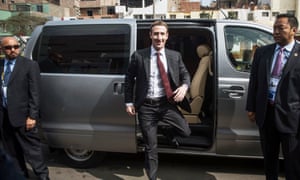
Facebook CEO Mark Zuckerberg in Lima. The social media
giant has faced increasing criticism for its power to polarize.
Photograph: Ernesto Benavides/AFP/Getty Images
Social media companies have faced increased scrutiny over the past
year as critics increasingly link growing political divisions across the
globe to the handful of platforms that dominate online discourse.
Many observers attributed the unexpected outcomes of the 2016 US
presidential election and Brexit referendum at least in part to the
ideological echo chambers created by Facebook’s algorithms, as well as
the proliferation of fake news, conspiracy mongering, and propaganda
alongside legitimate news sources in Facebook’s news feeds.
The company only recently acknowledged that it sold advertisements to
Russian operatives seeking to sow division among US voters during the
2016 election.
Facebook has also faced significant criticism for its role in amplifying anti-Rohingya propaganda in Myanmar amid suspected ethnic cleansing of the Muslim minority.
Palihapitiya referenced a case from the Indian state of Jharkhand
this spring, when false WhatsApp messages warning of a group of
kidnappers led to the lynching of seven people. WhatsApp is owned by Facebook.
“That’s what we’re dealing with,” Palihapitiya said. “Imagine when
you take that to the extreme where bad actors can now manipulate large
swaths of people to do anything you want. It’s just a really, really bad
state of affairs.”
Facebook did not immediately respond to a request for comment.
Blue Planet 2 demonstrated the terrifyingly fragile state of nature’s ecosystem. One of the key messages from the BBC series was that a delicate balance exists in the oceans between predators and prey. If there are too many predators, the stocks of prey fall. The predators go hungry and their numbers dwindle, allowing the prey to recover. Balance is restored.
Humans have their equivalent of this predator-prey model. It is best demonstrated by the workings of the labour market, where there is a constant struggle between employers and employees over the proceeds of growth. Unlike the world of nature, though, there is no self-righting mechanism. One side can carry on devouring its prey until the system breaks down. Over the past 40 years, employers have been the predators, workers the prey.
Consider the facts. By almost any measure, the past decade has been a disaster for living standards. Unemployment has fallen from its post financial-crisis peaks across the developed world but workers have found it hard to make ends meet. Earnings growth has halved in the UK even though the latest set of unemployment figures show that the jobless rate is the lowest since 1975.
The reason is not hard to find. Unions are far less powerful; collective bargainingin most of the private sector is a thing of the past; part-time working has boomed; and people who were once employed by a company are now part of the gig economy.
These changes in the labour market are by no means confined to the UK or US. European countries that were at the sharp end of the financial crisis – Greece, Ireland, Portugal, Spain, Cyprus – found that the cost of help was a programme of wage cuts, austerity and privatisation.
Clearly, the financial crisis has been a factor. Earnings growth in the UK in the decade before the banking meltdown was 4% to 4.5%; since 2008 it has struggled to reach half that level. But it would be a mistake to see the financial crisis as representing a break with the past. Rather, it intensified a process that had been going on since the 1970s, a process that can only really be understood by use of the C-word: class.
Seen in the simplest terms, the story of political economy over the past four decades is a class war between capital and labour, which capital has won hands down. The battlefield is littered with evidence of labour’s defeat: nugatory pay awards, precarious work, the collapse of collective bargaining, and cuts in public spending.
And to the victors have gone the spoils: higher profits and dividends; lower personal tax rates; a higher share of national income. Life for those at the top has carried on much as before, even as the average worker has experienced the worst decade for wage growthsince the 19th century. Unsurprisingly, it sticks in the craw for those whose living standards are going down to see the 1% whooping it up. Nobody likes to have their nose rubbed in it.
Advertisement
There was a time when parties of the centre-left would have been the beneficiaries of this resentment. Yet the German Social Democrats have just had their worst electoral result since the second world war; the French Socialist party has been reduced to a rump; the Greek socialist party Pasok has been wiped out; Hillary Clinton managed to lose the race for the White House to Donald Trump. In Spain and the Netherlands the story is the same. Everywhere there is palpable unhappiness about what is seen as a rigged system; but other than in the UK, it has not translated into support for parties of the mainstream left.
An explanation for this is provided by William Mitchell and Thomas Fazi in their book Reclaiming the State: the left has given up on the politics of class and concentrated on the politics of identity. And while this has led to some worthy victories, none of them has actually challenged turbo-charged capitalism, which has had the field to itself.
There are still one or two politicians around who are unembarrassed about espousing the politics of class. Bernie Sanders is one; Jeremy Corbyn is another. Neither has bought into the argument – increasingly prevalent on the left since the 1970s – that nation states are powerless in the face of global market forces. Rather, Sanders and Corbyn say the state can and should be used as aggressively by the left as it has been by the right. This runs counter to the whole third-way approach pursued by Bill Clinton in the US and Tony Blair in the UK, which stated that centre-left governments had to come to an accommodation with the markets, in which accommodation meant repealing Roosevelt’s curbs on Wall Street’s speculative activities and using taxpayers’ money to top up poverty wages through tax credits.
Labour’s current contortions over Brexit are evidence of the tension between these two worldviews. A chunk of the party – the bigger chunk – thinks the only way to counter the excesses of capitalism is at a supra-national EU level. Yet it is hard to square this belief with the 2007 Lisbon treaty, which commits member states to act in accordance with the principle of an open economy with free competition; frowns on state aid; and lays out disciplinary procedures for governments that run excessive deficits.
What’s more, neoliberal theory has been put into practice – which is why, when French and German banks lent recklessly to Greece, the imperative was to protect French and German bondholders rather than Greek workers.
It is a big – and debilitating – modern myth that the neoliberal revolution of the 1970s and the 1980s weakened the power of the state. What actually happened was that parties of the right refashioned and repurposed the state to undermine the power of labour and strengthen the power of capital. The enduring power of nation states was highlighted in the 2008 financial crisis, when it was only the willingness of governments to wade in with public money and taxpayer guarantees that prevented the entire global banking system from going bust.
So here are the options. Parties on the left can carry on believing that capitalism can be tamed at a transnational level, even though all the available evidence is that this is not going to happen. They can seek to use the power of the state for progressive ends, even though this will be strongly resisted. Or they can sit and watch as the predators munch their way through their prey. Even for the predators, this would be a disastrous outcome.