We'll leave the definitions till later. Right now, let's survey Horizon 3 and define it as the Horizon to define the landscape of what will impact me and the people I am responsible for the most. For the moment, I will discount the responsibility I have to the people at work, as those will be indirect co-workers rather than reporting subordinates.
It is frustratingly annoying when there is such an obvious gap for people development, and when push comes to shove, the solution is to allow the most undeserved and unqualified person to handle it. The lack of awareness that this is a critical function is alarming enough, then let alone the lack of finding a suitable solution, but dressing up a destructive "HR" to work things out, is extremely unacceptable. I understand that with the increased responsibilities that a promotion comes with, there's a need to load up - and that's a very forgiving perspective - but planting a dangerous timebomb seems to be a most awkward way of dealing with the situation. But of course, HRD is not seen as important, and therefore we will plod along.
So, that is one view. And thence, of course, the predictable counter views and compromises will kick in, and at the end we will settle.
The danger for me is allowing character C to handle this, and to own and have access to discreet information, that I know will not be dealt with objectively. Instead, it will be twisted and passed as situations for policy directions. Leader "don't let the truth get in the way" F will of course oblige, some strange calculations expressing itself in an unexplained decision, unsatisfactory to everyone but the one which will benefit. As a sidenote, leaving a situation without a satisfactory conclusion should not be an outcome that is acceptable to an effective leader. Make yourself unpopular if you will, but the strength of a decision should be that there is a clear direction of where to go.
Take Brexit as an example. A living proof of how not to handle with the greatest emotive impact to the greatest people. And mind you, the Brits are perhaps the most emotionless people you can fund - generally explained as grit and resilience of the British bulldog. An alternative explanation is manipulative, greedy and selfish bastard - especially as the greatest good concept does not truly apply. So, in one fell swoop, the greatest strength becomes the biggest vulnerability, exposing the whole proud nation to be the laughing stock of Europe and the world.
But I digress. Back to Horizon 3. Should I wait to see the push and pull arriving at a landing? It will not end well. The powers and authority will be concentrated to the top. My role will be diminished.
I have my finger on the eject button for some time now. What is holding me back is to see how it will impact my immediate charges. By March, most will be resolved. The first one will have clarity of where to go and at this time, may not require full backing. My backing is strong, but not great to undertake too much of a commitment. There's a few projects running concurrently that requires that fuel.
Horizon 3 therefore foresees a period of instability in the first few years that insyaAllah can be navigated safely unless something truly unanticipated comes along. The best option is to hold off that trigger finger, and seek replacement. That has not been too clear these past few months, but Allah has the Might and is All-Powerful. Strange that everything coalesces around same timeframes.
In Allah I lay my trust. He is All-Seeing and I do not. Many things have progressed in the past few months that had unanticipated positives.
One of the unintended cataclysmic outcomes of the Arab Spring was the unsustained rebellion in Syria. Assad was weakened, but backed by Russians, lived to fight another day, and now that he is given a roving blank cheque to do as he pleases, does exactly that.
The political history of how Assad and Baathists came to power can be traced to another British screw-up. That's another story - one to file under the World History of British Screw-ups that can be traced as a backstory to some of the world's violent and unstable spots.
Back to Assad. Removing him will remove the crimes, atrocities against humanity in Syria. Who would stand up for that? Obama wanted to circumvent gunboat diplomacy and Americam imperialism, but then swung too far into being the only superpower with the ability to project peace and justice to being a big democratic liberal softy snowflake in global diplomacy. Now that he's gone, we have a total nutter on the job.
Syria seems gone for now. Endured ISIS and now left to fend off Assad on her own.
The Muslim groups seem unable to blame Israel for this, and seem to be unable to create a campaign to save Syria from its implosion. Shouldn't saving Syria be a rational, objective option in the name of justice instructed in the Quran, even if it's a consequence not caused primarily by Israel?
Ya Allah, please save them. Save them from the Khawaarij who wage jihad in your name but taint Islam and peace instead. Save them from Assad and cultish groups who seek power, but are too insecure and bullying to wield that power. Save the children and the innocent.
It's true that I have sort of avoided this public introspection for some time now - gaining comfort by not questioning the fluctuating fortunes in life. The corresponding truism to that level of comport is that there is no tension and pressure to push for growth. No pain, no gain.
I was reflecting on an exchange that I had with Kahuna Uno almost three years ago, getting a memo signed off to complete the investment process where all the heavy lifting has been completed. I had completely forgotten the patronising tone in that "oh, you are probably new to this, but we need to do things like xyz, nvm you'll get used to this." The tone smacked of one so sure of himself, and so sure that I'm an insolent idiot unworthy to grace the little empire that he's delineated for himself.
Alhamdulillah - a number of calls I made were correct over time. That particular investment that prompted the above exchange is at 2x and seems on track for higher. Obviously, I can't properly pinpoint the exact sources of accuracy, it is all a combination of multiple sources and inputs. By the law of averages too, I'm due a swing, naudzubillah.
I'm under no delusions that no one is perfect, least of all me. But, this big show that Kahuna Uno displays when imitating the despotic tendencies of K's leadership style is pathetic. It's fine if various decisions are done well, but if you are left with dimes to the dollar, that's not great even if you are in audit compliance. Wha't worse is that the very people causing that loss in the first place is contrived to be given a second chance. But, at the same time the very same patronising tone is accorded to ones who are not in that priviledged profile.
It's easy to say, but I'll try my best to articulate without sounding too verbose - I'm sick of this faeces.
I'm all for startups. The small, motivated, driven entrepreneurs moving an idea to progress and hit the chinks of armour of the large, unwieldy giants of business. In Malaysia, the giants are really government agency behemoths masquerading as private enterprises, with most bureaucratic processes contained in loaded CYA behaviours, rolled over. No additional motivation to function beyond an artificially heightened glass ceiling, but a glass ceiling nonetheless. In any event, the "innovations" contained in the so-called GLCs / GLICs are more often than not the ability to circumvent typical JPA restrictions on recruitment. Ie Have your bureaucratic process but at the same time let's pay ourselves private market labour rates (and I mean the upper ranges, of course - let's not kid ourselves that we consider market rates to be anything other, certainly not mean/median/average - and here I am being mean). Also a loophole to go against artificial quotas that again restrict human endeavour.
At the end of it, it's a stalemate. Khazanah has gone a full circle now. At the beginning, its fresh mandate seemed like crashing the lethargy, and the narrative of how that has been done has been overwhelming in the intervening years. I had a contrarian view - refer my earlier posts. I was very much underwhelmed by Khazanah's first CEO appointment for TNB, the posturing and spin gave me a headache. No real focus on sweating the real resources to move things ahead, no real agenda apart from getting the best fat bonuses on offer. It was puke-worthy. Come the end of Amok's cycle, the sharks are now out - the narrative has changed. No real improvement, they say. That has to be narrative too, if by doing so the benefit can be made to accrue to a different "thought module". So, the real resources are left scratching their head in silence and thinking - WTH just happened? Was all this a sham? Were we taken for a ride?
Those questions are red herrings though. Substitute questions for not asking the right set of questions at the right times that may have changed the tide. "may" being the operational word.
The real questions are to ask what the real agenda was to bring people up, equipping them with skills, developing mental capacity, pushing the boundary. Just as the proxy questions could all be answered in the affirmative, it could be argued that the new "normal" is not sustainable, and has not been able to move things further than it should.
The solution to me is clear. Startups are way to go. Educating the right leaders to embrace risk and manage them clearly, building things up on a growth proxy would be the right approach. Business building is not easy. Business building and putting pressure to be on a continuous growth trajectory is a different scale of difficulty. FIDE rating 1500+ if I may. But it must. There is no other way.
The other way is contentment. And suddenly waking up one day that the tone has changed. The world is different. I have no place in it. And then it's too late.
May Allah grant me the strength to build a startup and give a bloody nose or two to these slowpokes.
In a way, Marc Z is doing it too well that the overall dominance is getting people scared. Having said that, Google's ubiquitousness(?) should have precipitated the same fears many years ago, and yet it does not and the Incognito mode seems to afford it an additional layer of credibility. However, digital privacy concerns are not going away.
The article points to a different effect of how "filter bubbles" based on algorithms and not "moralistic truth" wreak havoc on social structures. No one seems to care. See all the glazed eyes in MRTs and public spaces in melded extensions to their smartphones as evidence.
When the Quran speaks of your limbs communicating your truest intent seemingly against your very will to keep the truth hidden, it seems that man has found a way to carve it out, very much as what Allah had willed. Let's not get into a discussion of microexpressions yet, or whether gene expressions and DNA can embed the new behaviours into its biological programming.
Is there no doubt that this would have been discovered even before the Akhirah? Is there no doubt of the Truth contained in the God's Word in the Quran?
A former Facebook
executive has said he feels “tremendous guilt” over his work on “tools
that are ripping apart the social fabric of how society works”, joining a
growing chorus of critics of the social media giant.
Chamath Palihapitiya, who was vice-president for user growth at
Facebook before he left the company in 2011, said: “The short-term,
dopamine-driven feedback loops that we have created are destroying how
society works. No civil discourse, no cooperation, misinformation,
mistruth.” The remarks, which were made at a Stanford Business School event in November, were just surfaced by tech website the Verge on Monday.
“This is not about Russian ads,” he added. “This is a global problem
... It is eroding the core foundations of how people behave by and
between each other.”
Palihapitiya’s comments last month were made one day after Facebook’s founding president, Sean Parker, criticized
the way that the company “exploit[s] a vulnerability in human
psychology” by creating a “social-validation feedback loop” during an
interview at an Axios event.
Parker had said that he was “something of a conscientious objector”
to using social media, a stance echoed by Palihapitaya who said that he
was now hoping to use the money he made at Facebook to do good in the
world.
“I can’t control them,” Palihapitaya said of his former employer. “I
can control my decision, which is that I don’t use that shit. I can
control my kids’ decisions, which is that they’re not allowed to use
that shit.”
He also called on his audience to “soul search” about their own
relationship to social media. “Your behaviors, you don’t realize it, but
you are being programmed,” he said. “It was unintentional, but now you
gotta decide how much you’re going to give up, how much of your
intellectual independence.”
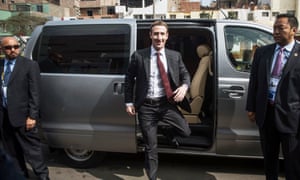
Facebook CEO Mark Zuckerberg in Lima. The social media
giant has faced increasing criticism for its power to polarize.
Photograph: Ernesto Benavides/AFP/Getty Images
Social media companies have faced increased scrutiny over the past
year as critics increasingly link growing political divisions across the
globe to the handful of platforms that dominate online discourse.
Many observers attributed the unexpected outcomes of the 2016 US
presidential election and Brexit referendum at least in part to the
ideological echo chambers created by Facebook’s algorithms, as well as
the proliferation of fake news, conspiracy mongering, and propaganda
alongside legitimate news sources in Facebook’s news feeds.
The company only recently acknowledged that it sold advertisements to
Russian operatives seeking to sow division among US voters during the
2016 election.
Facebook has also faced significant criticism for its role in amplifying anti-Rohingya propaganda in Myanmar amid suspected ethnic cleansing of the Muslim minority.
Palihapitiya referenced a case from the Indian state of Jharkhand
this spring, when false WhatsApp messages warning of a group of
kidnappers led to the lynching of seven people. WhatsApp is owned by Facebook.
“That’s what we’re dealing with,” Palihapitiya said. “Imagine when
you take that to the extreme where bad actors can now manipulate large
swaths of people to do anything you want. It’s just a really, really bad
state of affairs.”
Facebook did not immediately respond to a request for comment.
Blue Planet 2 demonstrated the terrifyingly fragile state of nature’s ecosystem. One of the key messages from the BBC series was that a delicate balance exists in the oceans between predators and prey. If there are too many predators, the stocks of prey fall. The predators go hungry and their numbers dwindle, allowing the prey to recover. Balance is restored.
Humans have their equivalent of this predator-prey model. It is best demonstrated by the workings of the labour market, where there is a constant struggle between employers and employees over the proceeds of growth. Unlike the world of nature, though, there is no self-righting mechanism. One side can carry on devouring its prey until the system breaks down. Over the past 40 years, employers have been the predators, workers the prey.
Consider the facts. By almost any measure, the past decade has been a disaster for living standards. Unemployment has fallen from its post financial-crisis peaks across the developed world but workers have found it hard to make ends meet. Earnings growth has halved in the UK even though the latest set of unemployment figures show that the jobless rate is the lowest since 1975.
The reason is not hard to find. Unions are far less powerful; collective bargainingin most of the private sector is a thing of the past; part-time working has boomed; and people who were once employed by a company are now part of the gig economy.
These changes in the labour market are by no means confined to the UK or US. European countries that were at the sharp end of the financial crisis – Greece, Ireland, Portugal, Spain, Cyprus – found that the cost of help was a programme of wage cuts, austerity and privatisation.
Clearly, the financial crisis has been a factor. Earnings growth in the UK in the decade before the banking meltdown was 4% to 4.5%; since 2008 it has struggled to reach half that level. But it would be a mistake to see the financial crisis as representing a break with the past. Rather, it intensified a process that had been going on since the 1970s, a process that can only really be understood by use of the C-word: class.
Seen in the simplest terms, the story of political economy over the past four decades is a class war between capital and labour, which capital has won hands down. The battlefield is littered with evidence of labour’s defeat: nugatory pay awards, precarious work, the collapse of collective bargaining, and cuts in public spending.
And to the victors have gone the spoils: higher profits and dividends; lower personal tax rates; a higher share of national income. Life for those at the top has carried on much as before, even as the average worker has experienced the worst decade for wage growthsince the 19th century. Unsurprisingly, it sticks in the craw for those whose living standards are going down to see the 1% whooping it up. Nobody likes to have their nose rubbed in it.
Advertisement
There was a time when parties of the centre-left would have been the beneficiaries of this resentment. Yet the German Social Democrats have just had their worst electoral result since the second world war; the French Socialist party has been reduced to a rump; the Greek socialist party Pasok has been wiped out; Hillary Clinton managed to lose the race for the White House to Donald Trump. In Spain and the Netherlands the story is the same. Everywhere there is palpable unhappiness about what is seen as a rigged system; but other than in the UK, it has not translated into support for parties of the mainstream left.
An explanation for this is provided by William Mitchell and Thomas Fazi in their book Reclaiming the State: the left has given up on the politics of class and concentrated on the politics of identity. And while this has led to some worthy victories, none of them has actually challenged turbo-charged capitalism, which has had the field to itself.
There are still one or two politicians around who are unembarrassed about espousing the politics of class. Bernie Sanders is one; Jeremy Corbyn is another. Neither has bought into the argument – increasingly prevalent on the left since the 1970s – that nation states are powerless in the face of global market forces. Rather, Sanders and Corbyn say the state can and should be used as aggressively by the left as it has been by the right. This runs counter to the whole third-way approach pursued by Bill Clinton in the US and Tony Blair in the UK, which stated that centre-left governments had to come to an accommodation with the markets, in which accommodation meant repealing Roosevelt’s curbs on Wall Street’s speculative activities and using taxpayers’ money to top up poverty wages through tax credits.
Labour’s current contortions over Brexit are evidence of the tension between these two worldviews. A chunk of the party – the bigger chunk – thinks the only way to counter the excesses of capitalism is at a supra-national EU level. Yet it is hard to square this belief with the 2007 Lisbon treaty, which commits member states to act in accordance with the principle of an open economy with free competition; frowns on state aid; and lays out disciplinary procedures for governments that run excessive deficits.
What’s more, neoliberal theory has been put into practice – which is why, when French and German banks lent recklessly to Greece, the imperative was to protect French and German bondholders rather than Greek workers.
It is a big – and debilitating – modern myth that the neoliberal revolution of the 1970s and the 1980s weakened the power of the state. What actually happened was that parties of the right refashioned and repurposed the state to undermine the power of labour and strengthen the power of capital. The enduring power of nation states was highlighted in the 2008 financial crisis, when it was only the willingness of governments to wade in with public money and taxpayer guarantees that prevented the entire global banking system from going bust.
So here are the options. Parties on the left can carry on believing that capitalism can be tamed at a transnational level, even though all the available evidence is that this is not going to happen. They can seek to use the power of the state for progressive ends, even though this will be strongly resisted. Or they can sit and watch as the predators munch their way through their prey. Even for the predators, this would be a disastrous outcome.
How do we verify explanations when we can't differentiate verified aspersions to declarations by the tin-foil hat brigade? Will it then be left primarily to confirmation bias i.e. if it fits your world-view then it must be true?
I have no answer apart from the need to conduct our own verification - this is also a Quranic injunction. But Monbiot is a writer I follow who exposes all these queasy relationships - his view is the threat to the progressive liberal space. My view is trying to understand the world and fashion a position for a response. Just like Fisk, whose views on the Middle East is so shockingly non-mainstream for western Judeo-Christian political worldview, Monbiot is not afraid to speak his mind.
The fourth estate still lives in the western world.
========
From: http://www.monbiot.com/2017/02/04/dark-arts/ and Guardian
How a dark money network is taking power on both sides of the Atlantic.
By George Monbiot, published in the Guardian 3rd February 2017
It took corporate America a while to warm to Donald Trump. Some of his positions, especially on trade, horrified business leaders. Many of them favoured Ted Cruz or Scott Walker. But once he had secured the nomination, the big money began to recognise an unprecedented opportunity.
Trump was prepared not only to promote the cause of corporations in government, but to turn government into a kind of corporation, staffed and run by executives and lobbyists. His incoherence was not a liability but an opening: his agenda could be shaped. And the dark money network that some American corporations had already developed was perfectly positioned to shape it.
Dark money is the term used in the US for the undisclosed funding of organisations involved in political advocacy. Few people would see a tobacco company as a credible source on public health, or a coal company as a neutral commentator on climate change. To advance their political interests, such companies must pay others to speak on their behalf.
Soon after the Second World War, some of America’s richest people began setting up a network of thinktanks to promote their interests. These purport to offer dispassionate opinions on public affairs. But they are more like corporate lobbyists, working on behalf of those who founded and fund them. These are the organisations now running much of the Trump administration.
We have no hope of understanding what is coming until we understand how the dark money network operates. The remarkable story of a British member of parliament provides a unique insight into this network, on both sides of the Atlantic. His name is Liam Fox. Six years ago, his political career seemed to be over.
The scandal he had caused by mixing his private and official interests, that was highly embarrassing to David Cameron’s government, had forced him to resign as Secretary of State for Defence. But today he is back on the front bench, with a crucial and sensitive portfolio: Secretary of State for International Trade.
In 1997, the year the Conservatives lost office to Tony Blair, Liam Fox, who sits on the hard right of the parliamentary Conservative party, founded an organisation called The Atlantic Bridge. Its patron was Margaret Thatcher. On its advisory council sat the future cabinet ministers Michael Gove, George Osborne, William Hague and Chris Grayling. Fox, who became a leading campaigner for Brexit, described the mission of The Atlantic Bridge as “to bring people together who have common interests”. It would defend these interests from “European integrationists who would like to pull Britain away from its relationship with the United States”.
The Atlantic Bridge was later registered as a charity. It was part of the UK’s own dark money network: only after it collapsed did we discover the full story of who had funded it.
Another funder was the drug company Pfizer. It paid for a researcher at The Atlantic Bridgecalled Gabby Bertin. She went on to become David Cameron’s press secretary, and now sits in the House of Lords: Cameron gave her a life peerage in his resignation honours list.
In 2007, a group called the American Legislative Exchange Council (ALEC) set up a sister organisation, The Atlantic Bridge Project, to run the US arm of Fox’s initiative. ALEC is perhaps the most controversial of the corporate-funded thinktanks in the US. It specialises in bringing together corporate lobbyists with state and federal legislators to develop “model bills”. The legislators and their families enjoy lavish hospitality from the group, then take the model bills home with them, to promote as if they were their own initiatives.
Jon Kyle, now retired, is currently acting as the “sherpa” guiding Jeff Sessions’s nomination as Trump’s attorney general through the Senate.
Jim DeMint resigned his seat in the Senate to become president of the Heritage Foundation, which is probably, after ALEC, the second most controversial thinktank in America. It was founded with a large grant from Joseph Coors, heir to the Coors brewing empire, then built up with money from the banking and oil billionaire Richard Mellon Scaife. Like ALEC, it has been richly funded by the Koch Brothers. Heritage, under DeMint’s presidency, drove the attempt to ensure that Congress refused to pass the federal budget, temporarily shutting down the government. Fox’s former special adviser at the Ministry of Defence, an American called Luke Coffey, now works for the foundation.
It will, if passed, inflict devastating cuts on healthcare, social security, legal aid, financial regulation and environmental protections, eliminate programmes to prevent violence against women, to defend civil rights and fund the arts, and will privatise the Corporation for Public Broadcasting. Trump, as you follow this story, begins to look less like a president and more like an intermediary: implementing an agenda that has been handed down to him.
In July last year, soon after he became trade secretary, Liam Fox flew to Washington. One of his first stops was a place he has visited often over the past 15 years: the office of the Heritage Foundation, where he spoke among others to Jim DeMint. A freedom of information request reveals that one of the topics raised at the meeting was the European ban on American chicken washed in chlorine: a ban that producers hope the UK will lift under a new trade agreement. Afterwards, Fox wrote to DeMint, looking forward to “working with you as the new UK government develops its trade policy priorities, including in high value areas that we discussed such as defence.”
How did Fox get to be in this position, after the scandal that brought him down six years ago? The scandal itself provides a possible clue: it involved a crossing of the boundaries between public and private interests. The man who ran the UK branch of The Atlantic Bridge was his friend Adam Werrity, who operated out of Michael Hintze’s office building. Werrity’s work became entangled with Liam Fox’s official business as defence secretary. Werritty, who carried a business card naming him as Fox’s adviser but was never employed by the Ministry of Defence, joined the secretary of state on numerous ministerial visits overseas, and made frequent visits to Fox’s office.
By the time details of this relationship began to leak, the Charity Commission had investigated The Atlantic Bridge and determined that its work didn’t look very charitable. It had to pay back the tax from which it had been exempted (Hintze picked up the bill). In response, the trustees shut the organisation down. As the story about Adam Werrity’s unauthorised involvement in the business of government began to grow, Fox made a number of misleading statements. He was left with no choice but to resign.
So when Theresa May brought him back into government, and gave him a portfolio that should, in principle, involve setting clear boundaries between public and private interests, it was as strong a signal as we might receive about the intentions of her government.
The trade treaties that Fox is charged with developing set the limits of sovereignty. US food and environmental standards tend to be lower than ours, and they will become lower still if Trump gets his way. Any trade treaty we strike will create a common set of standards for products and services. Trump’s administration will demand that ours are adjusted downwards, so that US corporations can penetrate our markets without having to modify their practices. All the cards, following the Brexit vote, are in US hands: if the UK resists, there will be no treaty. What May needed – even before Trump became president – was a person prepared to strike such a deal.
As the Financial Times reports, “the election of Donald Trump has transformed the fortunes of Liam Fox”. He is now “an indispensable member of Theresa May’s front bench team”. The shadow diplomatic mission he developed through The Atlantic Bridge plugs him straight into the Trump administration.
Long before Trump won, campaign funding in the US had systematically corrupted the political system. A new analysis by US political scientists finds an almost perfect linear relationship, across 32 years, between the money gathered by the two parties for congressional elections and their share of the vote. But there has also been a shift over these years: corporate donors have come to dominate this funding.
By tying our fortunes to those of the United States, the government binds us into this system. This is part of what Brexit is about: European laws protecting the public interest were portrayed by Conservative Eurosceptics as intolerable intrusions on corporate freedom. Taking back control from Europe means closer integration with the US. The transatlantic special relationship is a special relationship between political and corporate power.
In April 1938, President Franklin Roosevelt sent the US Congress the following warning. “The liberty of a democracy is not safe if the people tolerate the growth of private power to a point where it becomes stronger than their democratic state itself. That, in its essence, is fascism.” It is a warning we would do well to remember.